SparseCore Kernel 编写指南#
SparseCore 专门处理稀疏内存访问和运算,在现代 TPU 的多个版本中都是核心组件。虽然大部分矩阵乘法和计算密集型工作由 TensorCore 完成,但将某些计算卸载到 SparseCore 可以提升整体性能。
本指南将概述 SparseCore 硬件架构,并展示如何编写在 TPU SparseCore 上运行的 Pallas kernel。
from functools import partial
import jax
from jax.experimental import pallas as pl
from jax.experimental.pallas import tpu as pltpu
from jax.experimental.pallas import tpu_sc as plsc
import jax.numpy as jnp
import numpy as np

assert pltpu.get_tpu_info().sparse_core is not None, "No SparseCore found"硬件概述#
根据版本不同,一个 TPU 芯片可能包含 2 或 4 个 SparseCore。每个 SparseCore 由多个 subcore 组成,每个 subcore 拥有独立的 VMEM 空间。下图展示了 TPU 内部 SparseCore 的结构:
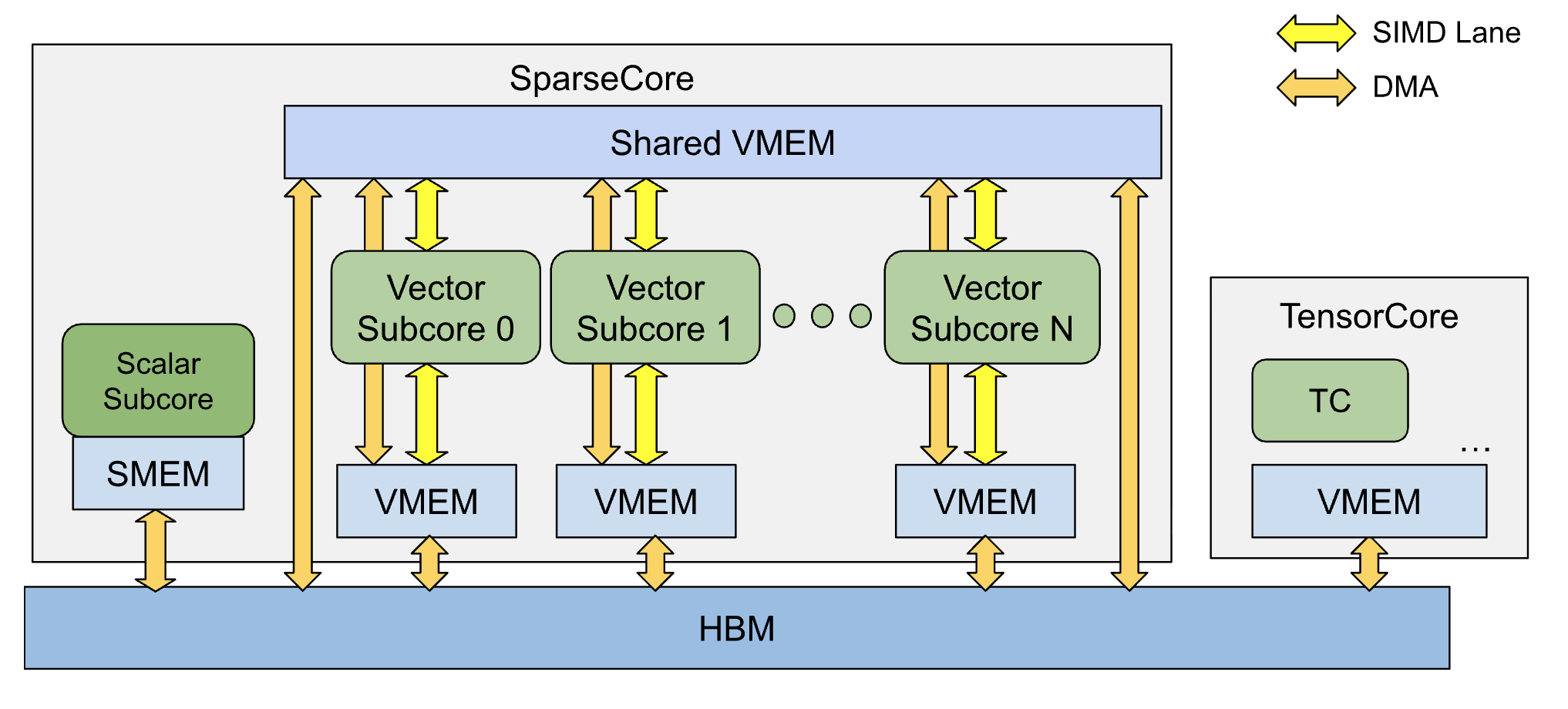
各组件说明:
Vector subcore(tiles):SparseCore 的向量处理子核心。每个 subcore 有独立的内存,数据流彼此独立。
Lanes(SIMD 宽度):SC vector subcore 以"单指令多数据"(SIMD)方式对大小为 N 的向量执行计算。一条 lane 中的所有数据在单条指令中同时处理。
Scalar subcore:SparseCore 的标量处理子核心,支持标量运算、动态索引以及发起 DMA 和 stream 操作。
Memory spaces:每个 vector subcore 拥有独立的 VMEM 和 SMEM(图中未标注)空间,此外还可以访问共享的 VMEM 空间。Scalar subcore 有自己的 SMEM。所有这些空间都与 TPU 的 HBM 相连。
在 Pallas 中,VMEM 空间表示为
pltpu.VMEM和pltpu.VMEM_SHARED,SMEM 表示为pltpu.SMEM。在其他文档中,共享 VMEM 通常称为"SPMEM",而每个 subcore 的 VMEM 称为"TileSPMEM"或"local SPMEM"。
实际规格因 TPU 版本而异。以下是一些已公开的 TPU 规格:
| 属性 | TPU v4 | TPU v5p | TPU v6e (Trillium) | TPU 7x (Ironwood) |
|---|---|---|---|---|
| SparseCore / 芯片 | 4 | 4 | 2 | 2(4 个物理核心) |
| Vector subcore / SparseCore | 16 | 16 | 16 | 16 |
| SIMD 宽度 | 8 | 8 | 8 (F32) / 16 (BF16) | 16 (F32) / 32 (BF16) |
| HBM 容量 | 32 GiB | 96 GiB | 32 GiB | 192 GB |
也可以使用 pltpu.get_tpu_info() 快速获取当前硬件的规格信息。
# 快速查询基本 SC 信息

assert (sc_info := pltpu.get_tpu_info().sparse_core)
print(f"SparseCore info for TPU {pltpu.get_tpu_info().chip_version}:")
print(sc_info)
SparseCore info for TPU 7x:
SparseCoreInfo(num_cores=2, num_subcores=16, num_lanes=16, dma_granule_size_bytes=64)运算与适用场景#
一个 SparseCore 包含 16 个较小的处理单元,每个单元有独立的数据流。这使其擅长具有以下特征的工作负载:
- 高度并行且不规则
- 随机数据访问
- 中等到较低的计算量
- 频繁的数据通信
SparseCore 上的一些常用操作包括:
- 小规模向量算术运算
- Gather 和 scatter(索引取值与写入)
- 排序、去重、计数、直方图
- Ragged 操作
表达 SparseCore 硬件#
与 TensorCore 类似,Pallas 使用 mesh 来表达 SparseCore 中的计算单元。根据要使用的处理单元类型,创建 ScalarSubcoreMesh 或 VectorSubcoreMesh。
注意 VectorSubcoreMesh 有两个维度——core 表示不同的 SparseCore,subcore 表示每个 SparseCore 上的多个子核心。
这允许你将 TensorCore 的编程模型应用到 SparseCore 上编写集合通信操作。如需了解更多,请参阅 集合通信指南。
scalar_mesh = plsc.ScalarSubcoreMesh(
    axis_name="core", num_cores=sc_info.num_cores
)
print(scalar_mesh)

vector_mesh = plsc.VectorSubcoreMesh(
    core_axis_name="core", subcore_axis_name="subcore"
)
print(vector_mesh)
ScalarSubcoreMesh(axis_name='core', num_cores=2)
VectorSubcoreMesh(core_axis_name='core', subcore_axis_name='subcore', num_cores=2, num_subcores=16)基本 SparseCore kernel#
以下是一个简单的 scalar subcore kernel,包含 DMA、按核心定制和计算操作。注意 scalar subcore 只能执行标量运算。
@jax.jit
def cumsum(x):
  @pl.kernel(
      out_shape=x,
      mesh=scalar_mesh,
      scratch_shapes=[
          pltpu.SMEM((x.shape[1],), x.dtype),
          pltpu.SemaphoreType.DMA,
      ],
  )
  def kernel(x_ref, o_ref, tmp_ref, sem):
    idx = jax.lax.axis_index('core')
    pltpu.async_copy(x_ref.at[idx], tmp_ref, sem).wait()

    @pl.loop(1, x.shape[1])
    def _(i):
      tmp_ref[i] += tmp_ref[i - 1]

    pltpu.async_copy(tmp_ref, o_ref.at[idx], sem).wait()

  return kernel(x)


x_shape = (sc_info.num_cores, sc_info.num_lanes)
x = jax.random.randint(jax.random.key(0), x_shape, 0, 64, jnp.int32)
np.testing.assert_array_equal(cumsum(x), jnp.cumsum(x, axis=1))
SparseCore kernel 中的流水线#
你可以使用 pltpu.emit_pipeline 编写流水线化的 SparseCore kernel。emit_pipeline 的 core_axis_name 和 dimension_semantics 参数用于在 SparseCore/subcore 之间划分流水线。
SC_REG_OP_SHAPE = (1, sc_info.num_lanes)
dma_block = (8, 128)


@jax.jit
def sc_add_one(x):
  @pl.kernel(out_shape=x, mesh=vector_mesh, scratch_shapes=[])
  def sc_add_one_kernel(x_hbm_ref, o_hbm_ref):
    in_shape = x_hbm_ref.shape

    def sc_add_one_body(in_vmem, out_vmem):
      @pl.loop(0, in_vmem.shape[0], step=SC_REG_OP_SHAPE[0])
      def _(c0):
        @pl.loop(0, in_vmem.shape[1], step=SC_REG_OP_SHAPE[1])
        def _(c1):
          slc = (pl.ds(c0, SC_REG_OP_SHAPE[0]), pl.ds(c1, SC_REG_OP_SHAPE[1]))
          out_vmem.at[*slc][...] = in_vmem.at[*slc][...] + 1

    pltpu.emit_pipeline(
        sc_add_one_body,
        grid=(in_shape[0] // dma_block[0], in_shape[1] // dma_block[1]),
        in_specs=[
            pl.BlockSpec(block_shape=dma_block, index_map=lambda i, j: (i, j))
        ],
        out_specs=[
            pl.BlockSpec(block_shape=dma_block, index_map=lambda i, j: (i, j))
        ],
        core_axis_name=('core', 'subcore'),
        dimension_semantics=(pltpu.PARALLEL, pltpu.PARALLEL),
    )(x_hbm_ref, o_hbm_ref)

  return sc_add_one_kernel(x)


x = jax.random.randint(jax.random.key(0), (4096, 128), 0, 64, jnp.int32)
y = sc_add_one(x)
np.testing.assert_array_equal(y, x + 1)
或者,你也可以使用 axis_index 计算核心索引,并用它在各核心之间分配工作(示例见此处)。
重叠 TensorCore 和 SparseCore#
将 TensorCore 和 SparseCore 的 kernel 重叠执行非常简单:只需将它们放在同一个 jax.jit 中即可。XLA 编译器会处理它们的调度。
@jax.jit
def tc_add_one(x):
  return x + 1


np.testing.assert_array_equal(tc_add_one(x), jnp.add(x, 1))


@jax.jit
def two_add_ones(x):
  return sc_add_one(x), tc_add_one(x)


jax.tree.map(np.testing.assert_array_equal, two_add_ones(x), (x + 1, x + 1));
以下基准测试显示,两者合并执行的总时间小于分别执行之和:
%timeit sc_add_one(x).block_until_ready()
%timeit tc_add_one(x).block_until_ready()

%timeit jax.block_until_ready(two_add_ones(x))
120 us +- 2.46 us per loop (mean +- std. dev. of 7 runs, 10000 loops each)
113 us +- 5.61 us per loop (mean +- std. dev. of 7 runs, 10000 loops each)
199 us +- 2.24 us per loop (mean +- std. dev. of 7 runs, 10000 loops each)Gather 和 Scatter#
SparseCore 对索引取值和更新有专门的优化操作。给定一个 HBM 中的输入或输出 ref(名为 data)和一个 VMEM 中的索引数组(名为 indices),它可以快速从 data[indices] 读取(“gather”)或向其写入(“scatter”)。
我们可以在 async_copy 或 sync_copy 中通过用索引 Ref 对 Ref 进行索引来使用这些 gather/scatter 操作。例如,sync_copy(data_ref.at[indices_ref], target_ref) 会触发一次 gather。
以下 kernel 通过流水线将索引加载到 vector subcore 的 VMEM 中。在循环体中,使用这些索引执行 gather 操作。
batch_size = 4096
value_dim = 128
gather_window_size = 128
num_steps = 1024
sc_num_cores, sc_num_subcores = sc_info.num_cores, sc_info.num_subcores
num_indices = gather_window_size * sc_num_cores * sc_num_subcores * num_steps
x = jnp.arange(batch_size * value_dim).reshape(batch_size, value_dim)
indices = jax.random.randint(
    jax.random.key(0), (num_indices,), 0, batch_size, jnp.int32
)


@jax.jit
def gather(x, indices):
  indices = indices.reshape((1, num_indices))

  @pl.kernel(
      out_shape=jax.ShapeDtypeStruct((num_indices, value_dim), x.dtype),
      mesh=vector_mesh,
  )
  def kernel(x_hbm, i_hbm, o_hbm):
    def body(i_vmem, o_vmem):
      pltpu.sync_copy(x_hbm.at[i_vmem.at[0]], o_vmem)  # gather 操作

    pltpu.emit_pipeline(
        body,
        grid=(num_indices // gather_window_size,),
        in_specs=[
            pl.BlockSpec((1, gather_window_size), index_map=lambda i: (0, i))
        ],
        out_specs=[
            pl.BlockSpec(
                (gather_window_size, value_dim), index_map=lambda i: (i, 0)
            )
        ],
        core_axis_name='subcore',
        dimension_semantics=(pltpu.PARALLEL,),
    )(i_hbm, o_hbm)

  return kernel(x, indices)


out = gather(x, indices)
np.testing.assert_array_equal(out, jnp.take(x, indices, axis=0))
如果你在 kernel 开头做索引取值,可以使用 plsc.BlockSpec 的 indexed_by 和 indexed_dim 参数,在顶层 pl.pallas_call 中将另一个输入作为当前输入在指定轴上的索引。
这个调用会将 HBM 到 VMEM 的 DMA 和执行索引查找的 gather 操作并行化,从而形成 4 个流水线阶段:索引拷入、gather、kernel 计算和输出拷出。这允许 gather 操作和后续对 gather 结果的计算重叠执行。
注意 plsc.BlockSpec 是实验性 API,可能会有变动。
@jax.jit
def gather_add_one(x, indices):
  @partial(
      pl.pallas_call,
      out_shape=jax.ShapeDtypeStruct((num_indices, value_dim), x.dtype),
      grid=(num_indices // gather_window_size,),
      in_specs=(
          plsc.BlockSpec(
              (gather_window_size, value_dim), indexed_by=1, indexed_dim=0
          ),
          pl.BlockSpec((gather_window_size,), lambda i: i),
      ),
      out_specs=pl.BlockSpec((gather_window_size, value_dim), lambda i: (i, 0)),
      compiler_params=pltpu.CompilerParams(
          kernel_type=pltpu.CoreType.SC_VECTOR_SUBCORE,
          dimension_semantics=(pltpu.PARALLEL,),
      ),
  )
  def kernel(gathered_ref, _, o_ref):
    # gathered_ref 是 x[indices] 的 gather 结果
    @pl.loop(0, gather_window_size)
    def _(c0):
      @pl.loop(0, o_ref.shape[1], step=16)
      def _(c1):
        slc = (pl.ds(c0, 1), pl.ds(c1, 16))
        o_ref.at[*slc][...] = gathered_ref.at[*slc][...] + 1

  return kernel(x, indices)


out = gather_add_one(x, indices)
np.testing.assert_array_equal(out, jnp.take(x, indices, axis=0) + 1)
Scatter(索引覆盖写入)是 gather 的逆操作。示例 kernel 如下:
@jax.jit
def scatter(x, indices):
  indices = indices.reshape((1, num_indices))

  @pl.kernel(
      out_shape=jax.ShapeDtypeStruct((batch_size, value_dim), x.dtype),
      mesh=vector_mesh,
      scratch_shapes=[],
  )
  def kernel(x_hbm, i_hbm, o_hbm):
    def body(x_vmem, i_vmem):
      pltpu.sync_copy(x_vmem, o_hbm.at[i_vmem.at[0]])  # scatter 操作

    pltpu.emit_pipeline(
        body,
        grid=(num_indices // gather_window_size,),
        in_specs=[
            pl.BlockSpec(
                (gather_window_size, value_dim), index_map=lambda i: (i, 0)
            ),
            pl.BlockSpec(
                (
                    1,
                    gather_window_size,
                ),
                index_map=lambda i: (0, i),
            ),
        ],
        out_specs=[],
        core_axis_name='subcore',
        dimension_semantics=(pltpu.PARALLEL,),
    )(x_hbm, i_hbm)

  return kernel(x, indices)


gathered = jnp.take(x, indices, axis=0)
out = scatter(gathered, indices)
np.testing.assert_array_equal(out, x)
与 TensorCore 的基准对比#
SparseCore 在 gather 和 scatter 操作上表现尤为出色。我们可以用默认运行在 TensorCore 上的原生 JAX API 实现相同功能,并比较结果。
%timeit jax.block_until_ready(gather(x, indices))

gather_tc = jax.jit(lambda x, i: jnp.take(x, i, axis=0))
gather_tc(x, indices).block_until_ready()

%timeit jax.block_until_ready(gather_tc(x, indices))
4.05 ms +- 2.02 us per loop (mean +- std. dev. of 7 runs, 100 loops each)
18.1 ms +- 5.24 us per loop (mean +- std. dev. of 7 runs, 100 loops each)